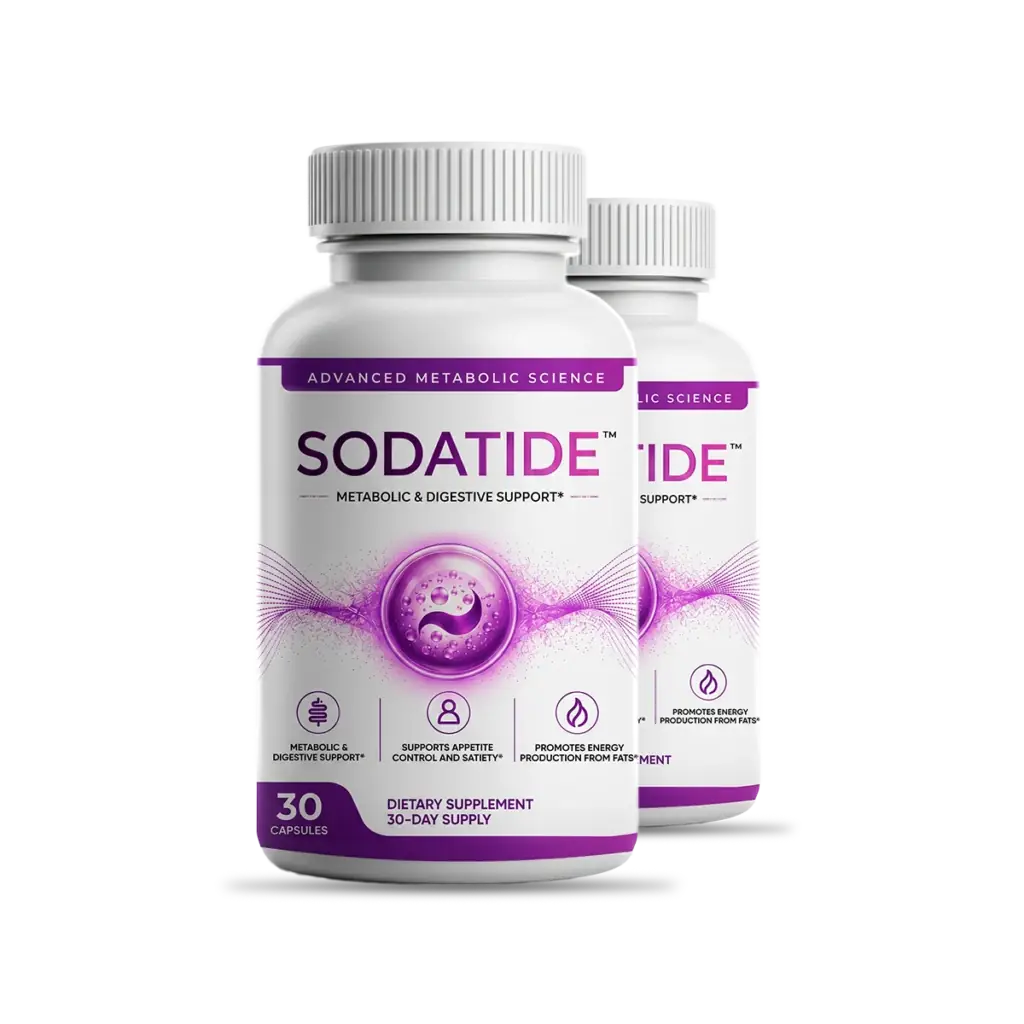
Two Bottles
60-day supply · 60 capsules
$79per bottle
$158 total · Plus shipping
- 2 bottles, 60 capsules
- Shipping charged, amount not published
- No bonuses at this tier
- 60-day money-back guarantee
Six steps through the formula: the daily format, what each component is there to do, and an honest account of what the amounts can and cannot support.
The formula rests on a straightforward and genuinely well-supported piece of biology: your large intestine hosts a dense population of bacteria, those bacteria ferment the carbohydrates that escape digestion in the small intestine, and the by-products of that fermentation matter to the gut lining and to the body more broadly.
Feed that population differently and it changes. That is the premise behind every prebiotic product, and it is sound as far as it goes.
SodaTide approaches it from two directions at once. It supplies fermentable substrate in the form of chicory root inulin and potato resistant starch, and it supplies live organisms in the form of a three-strain probiotic blend. The first feeds what is already there; the second adds to it.
The steps below explain each part. The final step covers the thing the sales page leaves out, which is what the actual amounts mean in practice.
From the morning capsule through to what consistency actually buys you.
One capsule, taken with an 8 oz glass of water. The seller recommends the morning, preferably before a meal, and the label directs you to refrigerate the bottle after opening.
That refrigeration instruction is not incidental — live cultures degrade with heat and time, so where you keep the bottle affects what you are taking.
Three actives, all printed on the label with their amounts: chicory root inulin at 211 mg, potato resistant starch at 100 mg, and a probiotic blend at 36 mg.
The remaining contents are the capsule shell (hypromellose, so vegetarian) plus microcrystalline cellulose, magnesium stearate and silica — standard excipients that hold a capsule together and keep powder flowing.
Inulin is a chain of fructose units that human digestive enzymes cannot break down. It travels intact to the colon, where bifidobacteria and others ferment it. This is one of the best-characterised prebiotic mechanisms there is.
Chicory root is the standard commercial source, and inulin from it has been studied extensively for effects on bacterial populations, bowel regularity and mineral absorption.
Resistant starch behaves like fibre rather than like starch: it resists digestion in the small intestine and reaches the colon intact, where fermentation produces short-chain fatty acids — particularly butyrate, the preferred fuel of the cells lining the colon.
Potato is a well-known source, and interestingly the resistant starch content of potato rises when it is cooked and then cooled, which is why cold potato salad is a better source than a hot baked potato.
Three named strains: Bifidobacterium infantis, a common resident of the infant gut and a well-studied probiotic; Clostridium butyricum, a butyrate producer used as a probiotic particularly in Japan; and Akkermansia muciniphila, a mucin-degrading organism that has attracted serious research interest for its association with metabolic health.
Pairing probiotics with prebiotics is a reasonable design idea — the substrate is there to support the organisms.
Microbiome changes are not immediate, and they are not permanent either — populations shift back when the input stops. The seller suggests at least 30 days before judging results, which is also the guarantee's condition.
What consistency genuinely helps with is the habit around it. A daily capsule that anchors a wider routine of better food, movement and sleep is doing useful work, even where the capsule's own contribution is small.
Everything above describes real mechanisms. This section covers scale, which is where the picture changes.
The label publishes exactly what is in a capsule, which is more than many products in this category manage. It also makes something plain that the sales page does not: these are small amounts.
To put the fibre figures in context: 211 mg is roughly one fifty-seventh of the 12 g intake behind the authorised inulin claim. You would get more inulin from a single small serving of onion, leek or asparagus, and considerably more resistant starch from a cooled cooked potato or a green banana.
This is arithmetic off the label, not an accusation. A capsule cannot hold 12 g of anything — that is a heaped tablespoon of powder. It does mean that if you are taking SodaTide for the prebiotic fibre specifically, the food on your plate will do considerably more of that work than the capsule will.
Probiotic products are normally declared in CFU — colony-forming units, the count of viable organisms per serving. That figure is what tells you whether a product resembles anything used in research, where doses commonly run into the billions.
SodaTide's label declares the blend by weight: 36 mg, with the three strains named underneath. Milligrams of powder say nothing about how many organisms are alive in it, and the two do not convert.
The refrigeration instruction on the label points the same way: live cultures degrade with heat and time, which is why viable counts, storage and shelf life normally travel together on a probiotic label. Asking the seller for the CFU count per capsule is a fair question, and the answer would tell you more than any other single number about this product.
None of this makes the mechanisms wrong. Inulin really is fermented by gut bacteria; resistant starch really does produce butyrate. The question is whether 211 mg and 100 mg are enough to shift anything measurably, and the published research — which works in grams — cannot answer that, because it has not tested amounts this small.
The reasonable conclusion: treat SodaTide as a small daily addition to a fibre-adequate diet, not as the source of your prebiotic intake. If it is the only prebiotic you are getting, the capsule is not where the shortfall gets fixed.
The studies referred to here examined individual ingredients on their own, at the intakes the researchers chose — which for inulin and resistant starch means gram quantities, many times what a capsule holds.
That research explains why an ingredient is interesting. It does not show that SodaTide reproduces those results, and no clinical trial of this finished product has been published.
The product label's own caution panel is the starting point, and it is a reasonable one.
SodaTide is a dietary supplement, not a medicine, and it is not intended to diagnose, treat, cure or prevent any disease.
No capsule replaces the things that actually shape digestive and metabolic health, and a page that implied otherwise would not be worth reading.
Total dietary fibre is the big one. Most adults fall well short of the 25–30 g a day generally recommended, and closing that gap through vegetables, pulses, whole grains, fruit and nuts does more for the gut microbiome than any supplement at these amounts. Physical activity, sleep and hydration each independently affect digestion and metabolic health.
SodaTide is positioned to complement those habits. It is not a substitute for them, and results depend far more on the habits than on the capsule.
The three packages currently listed by the seller. Every figure below is theirs, and the per-bottle arithmetic checks out on all three.
$158 total · Plus shipping

$294 total · Free US shipping

$207 total · Free US shipping
Arithmetic verified: $79×2=$158, $69×3=$207, $49×6=$294, and the 60/90/180-day supply figures match 30 capsules a bottle at one a day. The two-bottle package adds shipping and the reference does not state how much, so its delivered cost cannot be calculated here. These are current listed offers rather than permanent prices — confirm them at the official checkout before paying.
Every order is backed by a 60-day money-back guarantee running from the date of purchase, which gives you two full months to decide.
The published terms ask you to use the product for at least 30 days before requesting a refund, then contact support by email if you are not satisfied with the results, the product or the experience.
In practice that halves your decision window. You are asked to commit a month before a claim is entertained, which leaves roughly 30 days to make the request — less if delivery took a while. Worth diarising the date your 60 days ends.
Two details the terms do not specify: whether the 60 days runs from order or from delivery, and who pays return postage. Both are reasonable questions to put to support before ordering the larger packages.
Read the ingredients page first. This is a three-ingredient prebiotic and probiotic capsule with its amounts printed on the label, and those amounts are the most useful thing to understand before you spend anything.
From $49 per bottle · 60-day money-back guarantee · Free US shipping on 3 and 6 bottles