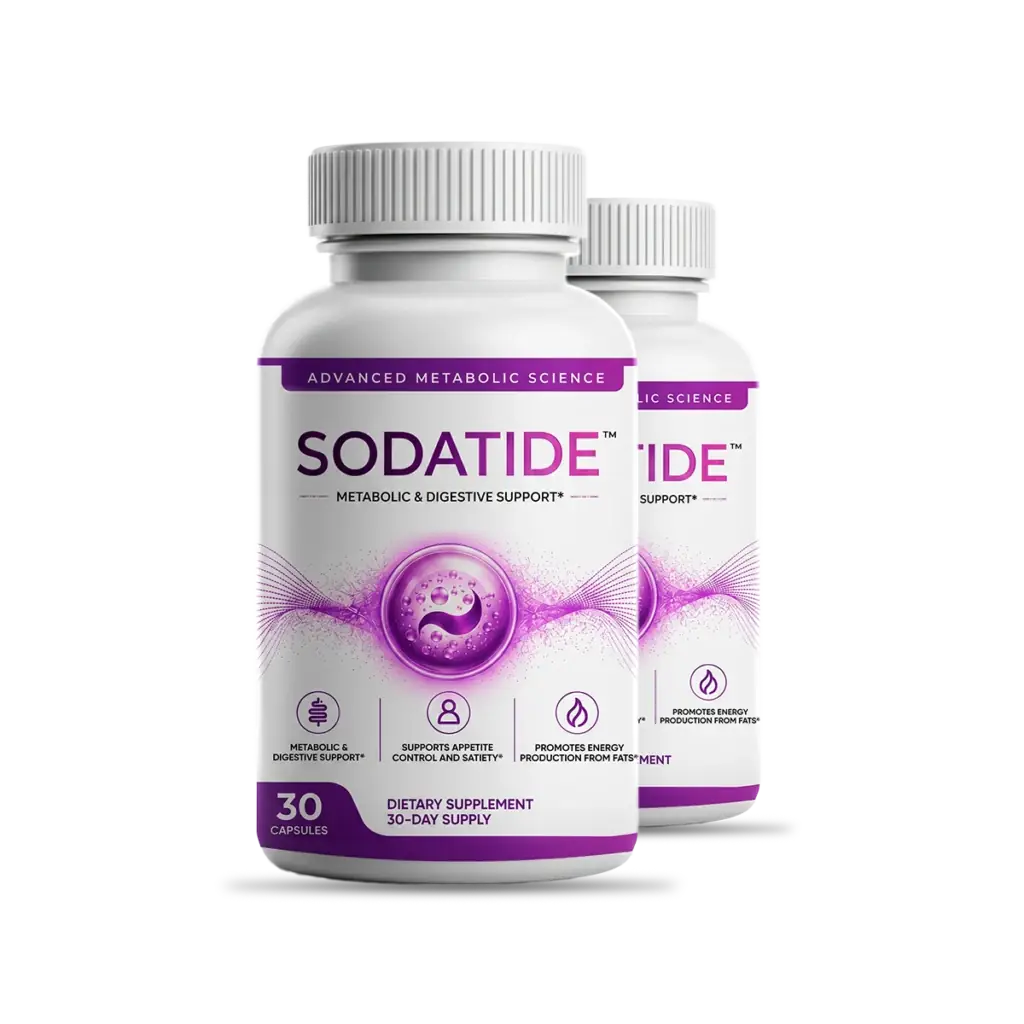
Two Bottles
60-day supply · 60 capsules
$79per bottle
$158 total · Plus shipping
- 2 bottles, 60 capsules
- Shipping charged, amount not published
- No bonuses at this tier
- 60-day money-back guarantee
Seven support areas, each measured honestly against what the ingredients and their amounts can actually contribute — followed by a plain list of what this product does not do.
Supporting a process means contributing to something your body already does. It does not mean driving it, fixing it, or producing a result independent of what you eat and how you live.
SodaTide is a dietary supplement, not a medicine. It is not intended to diagnose, treat, cure or prevent any disease, no weight-loss outcome is promised, and individual results may vary.

This is the claim closest to the formula's actual mechanism, and the one most worth taking seriously. Both fibres in SodaTide are fermentable, which means they reach the colon intact and become food for the bacteria living there.
That fermentation produces short-chain fatty acids, principally butyrate, acetate and propionate. Butyrate in particular is the preferred energy source of colonocytes — the cells lining the colon — and has been studied for its role in maintaining the gut barrier.
The probiotic strains add a second angle: live organisms which, while they generally do not permanently colonise, can influence the gut environment while they are passing through.
What responsible language looks like here: SodaTide is designed to support digestive wellness as part of a healthy routine. It is not a treatment for any digestive condition, and persistent digestive symptoms are a reason to see a doctor rather than buy a supplement.

A prebiotic is, by definition, a substrate selectively used by host microorganisms to confer a health benefit. Chicory root inulin is one of the most thoroughly studied examples in existence, and its inclusion here is entirely reasonable in principle.
Inulin is a fructan — a chain of fructose units that human digestive enzymes cannot cleave. It passes to the colon intact, where bifidobacteria in particular ferment it readily. Research has examined its effects on bacterial populations, stool frequency and calcium absorption, and a bowel-function health claim for chicory inulin is authorised in the European Union.
The important caveat is intake. That authorised claim requires 12 g of chicory inulin a day. SodaTide supplies 211 mg, roughly one fifty-seventh of it. Prebiotic research more broadly works in the 5–20 g range.
So the ingredient is well chosen and well evidenced; the amount is small. Both things are true, and a benefits page that mentioned only the first would not be much use to you.
The microbiome is the area where this formula's ambitions and the current state of the science are both genuinely interesting — and where careful language matters most.
Of the three strains, Akkermansia muciniphila is the one that has drawn serious research attention. It lives in the mucus layer of the gut and its abundance has been repeatedly associated with markers of metabolic health in observational work, with early human trial data now emerging.
Bifidobacterium infantis is a long-standing probiotic with research behind it, and Clostridium butyricum is a butyrate producer used as a probiotic in Japan for decades.
Two honest qualifications. Association is not causation, and much of the Akkermansia evidence is associative. And because no CFU count is published, there is no way to know how many viable organisms a capsule actually delivers.

Fibre and satiety are connected, and the connection is well established. Fibre adds bulk, slows gastric emptying and influences the gut hormones involved in signalling fullness. Diets higher in fibre are consistently associated with better appetite regulation.
Fermentation adds a second pathway: short-chain fatty acids produced in the colon have been studied for their effects on satiety signalling, which is part of why prebiotic research often measures appetite outcomes.
The qualification is the same one, and it is the honest heart of this page. Satiety studies use gram quantities of fibre. At 311 mg of total fermentable material, SodaTide is not going to fill you up, and no page should suggest otherwise.
What it can reasonably do is sit inside a routine where the fibre is genuinely coming from your meals. That is where healthy fullness actually comes from.

The link between the gut microbiome and metabolic health is one of the most active areas in nutrition research, and also one of the easiest to overstate. It deserves accurate treatment rather than enthusiasm.
What is reasonably established: microbiome composition differs between people with different metabolic profiles, short-chain fatty acids from fermentation have measurable physiological effects, and dietary fibre intake is consistently associated with better metabolic outcomes in large studies.
What is not established: that supplementing specific organisms or small amounts of prebiotic fibre reliably changes metabolic outcomes in humans. The research is early, the effects observed are generally modest, and the intakes used are far larger than what a capsule holds.
So this is a support claim in the proper sense of the word — a contribution to a system, not a lever on it. SodaTide is not a weight-loss product and no weight outcome is promised on this site.

Worth stating the scale of the underlying problem, because it is the context that makes this benefit meaningful and also puts the capsule in its place.
General recommendations put daily fibre intake at roughly 25–30 g for adults. Actual average intake in most Western countries falls a long way short — frequently around half of that. This is one of the genuine, unglamorous nutritional gaps in the modern diet.
SodaTide contributes 311 mg of fermentable material to that target. In plain terms, that is about one percent of it. A single pear, a cup of lentils or a bowl of oats will each deliver many times more.
The useful framing is a supplement to a fibre-adequate diet rather than a solution to a fibre-poor one. If your intake is low, the capsule is not the fix — but a daily habit that keeps you thinking about fibre may still be worth something.

The final benefit is the least scientific and possibly the most real: a daily supplement can function as an anchor habit.
Behaviour change research is consistent that habits attach best to existing routines and that small, repeatable actions outlast ambitious ones. A capsule taken with a morning glass of water is about as small and repeatable as an action gets.
For some people, that daily moment is a cue that keeps a wider set of intentions visible — the vegetables, the walk, the earlier bedtime. That is a genuine benefit, though it belongs to the routine rather than to the formula.
It is also the honest answer to "will this work?" — the capsule contributes a little, and the routine around it contributes most.
A benefits page listing only benefits is an advertisement.
The reference markets this product heavily around weight loss. This site does not repeat those claims, and it is worth saying why plainly.
No weight outcome is promised here, guaranteed or implied. The gut-microbiome-and-weight research is genuinely interesting and genuinely early, and the amounts in this capsule sit far below the intakes used in the studies that generated the interest.
If weight is what brought you here, the honest advice is that dietary pattern, activity, sleep and, where appropriate, medical support do the heavy lifting. A supplement can sit alongside those. It cannot stand in for them, and any product suggesting otherwise is selling you something.
The studies referred to here examined individual ingredients on their own, at the intakes the researchers chose — which for inulin and resistant starch means gram quantities, many times what a capsule holds.
That research explains why an ingredient is interesting. It does not show that SodaTide reproduces those results, and no clinical trial of this finished product has been published.
The label publishes exactly what is in a capsule, which is more than many products in this category manage. It also makes something plain that the sales page does not: these are small amounts.
To put the fibre figures in context: 211 mg is roughly one fifty-seventh of the 12 g intake behind the authorised inulin claim. You would get more inulin from a single small serving of onion, leek or asparagus, and considerably more resistant starch from a cooled cooked potato or a green banana.
This is arithmetic off the label, not an accusation. A capsule cannot hold 12 g of anything — that is a heaped tablespoon of powder. It does mean that if you are taking SodaTide for the prebiotic fibre specifically, the food on your plate will do considerably more of that work than the capsule will.
No capsule replaces the things that actually shape digestive and metabolic health, and a page that implied otherwise would not be worth reading.
Total dietary fibre is the big one. Most adults fall well short of the 25–30 g a day generally recommended, and closing that gap through vegetables, pulses, whole grains, fruit and nuts does more for the gut microbiome than any supplement at these amounts. Physical activity, sleep and hydration each independently affect digestion and metabolic health.
SodaTide is positioned to complement those habits. It is not a substitute for them, and results depend far more on the habits than on the capsule.
The three packages currently listed by the seller. Every figure below is theirs, and the per-bottle arithmetic checks out on all three.
$158 total · Plus shipping

$294 total · Free US shipping
$207 total · Free US shipping
Arithmetic verified: $79×2=$158, $69×3=$207, $49×6=$294, and the 60/90/180-day supply figures match 30 capsules a bottle at one a day. The two-bottle package adds shipping and the reference does not state how much, so its delivered cost cannot be calculated here. These are current listed offers rather than permanent prices — confirm them at the official checkout before paying.
Every order is backed by a 60-day money-back guarantee running from the date of purchase, which gives you two full months to decide.
The published terms ask you to use the product for at least 30 days before requesting a refund, then contact support by email if you are not satisfied with the results, the product or the experience.
In practice that halves your decision window. You are asked to commit a month before a claim is entertained, which leaves roughly 30 days to make the request — less if delivery took a while. Worth diarising the date your 60 days ends.
Two details the terms do not specify: whether the 60 days runs from order or from delivery, and who pays return postage. Both are reasonable questions to put to support before ordering the larger packages.
Read the ingredients page first. This is a three-ingredient prebiotic and probiotic capsule with its amounts printed on the label, and those amounts are the most useful thing to understand before you spend anything.
From $49 per bottle · 60-day money-back guarantee · Free US shipping on 3 and 6 bottles